Dr. Lu Lu
Neutrino Hunter
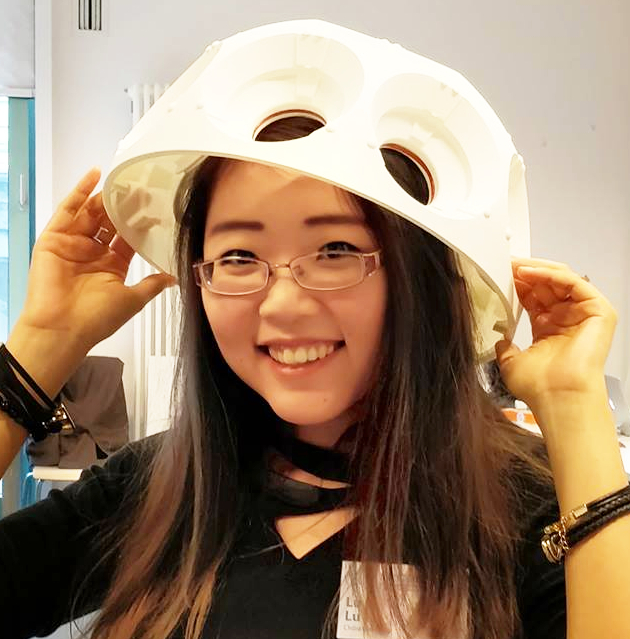
- Associate Professor @ WIPAC, University of Wisconsin–Madison
- Representative of the IceCube Collaboration (one of three) @ Global Neutrino Network (GNN)
- U.S. Physical Sciences Representative (one of three) @ Scientific Committee on Antarctic Research (SCAR)
The origins and acceleration mechanisms of the highest-energy particles in the Universe remain among the most enduring mysteries in modern physics. Studies of cosmic rays helped establish particle physics; today, we use the Earth’s atmosphere, Antarctic ice, and ocean water as components of vast detectors to probe this frontier. Do the laws of the Standard Model hold at extreme energies? Could these particles originate from dark matter or other new physics?
During my PhD at the University of Leeds (United Kingdom) and the University of Wuppertal (Germany), I searched for ultra-high-energy photons using data from the Pierre Auger Observatory. I then joined Chiba University (Japan) as a postdoctoral researcher, working on the IceCube Neutrino Observatory. I am grateful to my mentors: Alan Watson and Johannes Knapp in Leeds, Karl-Heinz Kampert in Wuppertal, and Shigeru Yoshida and Aya Ishihara in Chiba.
I lead a research group at WIPAC working across high-energy neutrino astrophysics, including real-time multimessenger observations, Galactic plane searches, diffuse flux measurements, and searches for the highest-energy neutrinos. My group focuses on analysis development, including simulation, reconstruction, and machine learning methods. I have also contributed to next-generation optical sensor development for IceCube-Gen2 and plan to extend this work in the future. My own contributions include the Glashow-resonance analysis, the TXS 0506+056 coincidence analysis, initiating the combined diffuse global fit and continued efforts, helping build the extremely-high-energy real-time alerts, the all-flavour Galactic neutrino analysis, and using AI methods to search for the highest-energy neutrinos.
Within the IceCube Collaboration, I previously served as co-lead of the Diffuse/Atmospheric Working Group and continue to serve on the Realtime Oversight Committee. My research is supported by external and institutional funding, including the NSF NSF ACED: From Radiation Therapy to the High-Energy Universe — Generative AI for Particle Tracking (as PI) and WoU-MMA: IceCube Data Analysis in the U.S. (2026–2029, as co-PI; 2025–2028 and 2022–2025, as senior personnel), together with UW–Madison awards (Research Forward, the Ray MacDonald Award, and the Fall Research Competition), and has been recognized by the International Union of Pure and Applied Physics (IUPAP) Early Career Scientist Prize and the IceCube Impact Award for leading the ICEcuBEAR project.
Research Interests
Where are the highest energy particles from?
Photons
From X-ray and gamma-ray to UHE photons, they carry key information on the highest-energy sources. Difficulty: the Universe is opaque and leptonic sources dominate.
Neutrinos
Neutrinos are weakly interacting and ideal for astronomy. My prime interests are PeV astrophysical neutrinos and EeV cosmogenic neutrinos.
UHECR
A more than 100-year mystery. Charged particles bend in magnetic fields, making source identification difficult; mass composition remains uncertain.
Multi-Messenger
Combining photons, neutrinos, cosmic rays, and gravitational waves offers the most promising path toward identifying the first UHE sources.
Physics-Informed AI
Physics-informed machine learning and generative modeling of particle showers from the Earth’s atmosphere and Antarctic ice to collider experiments.
Selected Projects
A timeline of the main projects I have worked on since joining IceCube in 2015, from detector hardware in Japan to the Galactic plane in Madison.
D-Egg: a dual-PMT optical module
A dual-PMT optical sensor for the next generation of IceCube, developed at Chiba University from design and simulation to laboratory validation.
- dual-PMT optical module (D-Egg) for IceCube-Gen2, ICRC 2015 poster
- D-Egg: a dual-PMT optical module for IceCube, 2023
The Glashow resonance
A particle shower detected at the Glashow-resonance energy, identified with a hybrid reconstruction combining electromagnetic and hadronic information.
IceCube-170922A and TXS 0506+056
A high-energy IceCube alert observed in spatial and temporal coincidence with gamma-ray activity from the blazar TXS 0506+056.
Extremely-high-energy alerts
The highest-energy component of IceCube’s real-time alert system, streaming candidate cosmic neutrinos to telescopes worldwide.
- IceCube Alerts for high energy neutrino astronomy, AMON workshop 2019 talk
- The Next Generation of IceCube Real-time Neutrino Alerts, PoS ICRC 2019
- IceCat-1: The IceCube Event Catalog of Alert Tracks, ApJS (2023)
Mapping the cosmic-neutrino spectrum
A global fit combining track- and shower-dominated IceCube samples under a common treatment of detector and atmospheric uncertainties. The results show evidence that the spectrum is not described by a single power law from 5 TeV to 10 PeV; updated analyses continue toward 10 PeV and beyond.
- Diffuse Workshop on Global Fit (organiser), September 2019
- Diffuse Workshop on Global Fit 2021 (organiser), May 2021
- Diffuse workshop on systematics and fitting tools 2021 (organiser, internal), October 2021
- Diffuse Global Fit – present and the future (organiser, internal), October 2023
- Characterizing the Astrophysical Neutrino Flux Using Contained and Uncontained Cascade Events in IceCube, PoS ICRC 2025
- Measurement of All Flavor PeV Neutrino Flux using Combined Datasets from IceCube, PoS ICRC 2025
- Evidence for a spectral break or curvature in the astrophysical-neutrino spectrum, 2026
Snowmass and multimessenger white papers
Community road maps for the field: high-energy and ultra-high-energy neutrinos in Snowmass, and the infrastructure for a collaborative multimessenger ecosystem. A CERN Courier feature surveys the detector concepts of the coming two decades.
- High-energy and ultra-high-energy neutrinos: a Snowmass white paper, JHEAp 36 (2022)
- Windows on the Universe: Establishing the Infrastructure for a Collaborative Multi-messenger Ecosystem, 2024
- Discovering the neutrino sky, CERN Courier feature, May 2025
Idealised cascade reconstruction and IceCube-Gen2
Idealised reconstruction for cascades: the shower angular resolution achievable in IceCube-Gen2 and its implications for diffuse science.
Interpreting the KM3NeT ultra-high-energy candidate
What the ultra-high-energy event candidate reported by KM3NeT implies: whether ultra-high-energy cosmic rays, neutrinos, and photons share a common origin, and how the IceCube and KM3NeT observations compare.
Probabilistic particle-shower modeling
Mean shower descriptions extended to include event-by-event fluctuations and their energy dependence, validated against FLUKA simulations.
Neutrinos from the Milky Way
The IceCube Multi-flavor Astrophysics Neutrino sample (ICEMAN): improved simulation, reconstruction, and event selection, establishing neutrino emission from the Galactic plane at 5.7σ.
Joint IceCube–Auger searches
Searches for transient ultra-high-energy sources using IceCube neutrinos and photon candidates from the Pierre Auger Observatory.
Energy flux and flavour composition of inner-Galaxy neutrinos
The energy flux and flavour composition of neutrinos from the inner Galaxy, following the Galactic-plane observation.
Galactic PeVatron searches
The hunt for Galactic PeVatrons: sources with gamma-ray emission above 100 TeV, a full-sky map of all-flavour neutrinos, the Cygnus bubble, cut-off energy measurements of H.E.S.S. PeVatron candidates, and Galactic stacking analyses.
All-flavour neutrino search beyond 10 PeV
Graph-neural-network and transformer selections for extremely high-energy events, extending IceCube’s reach across all neutrino flavours.
Generative AI for particle showers
Generative models of particle showers in two and three dimensions, building on the probabilistic shower-modeling work.
A more complete record is on INSPIRE.
Group
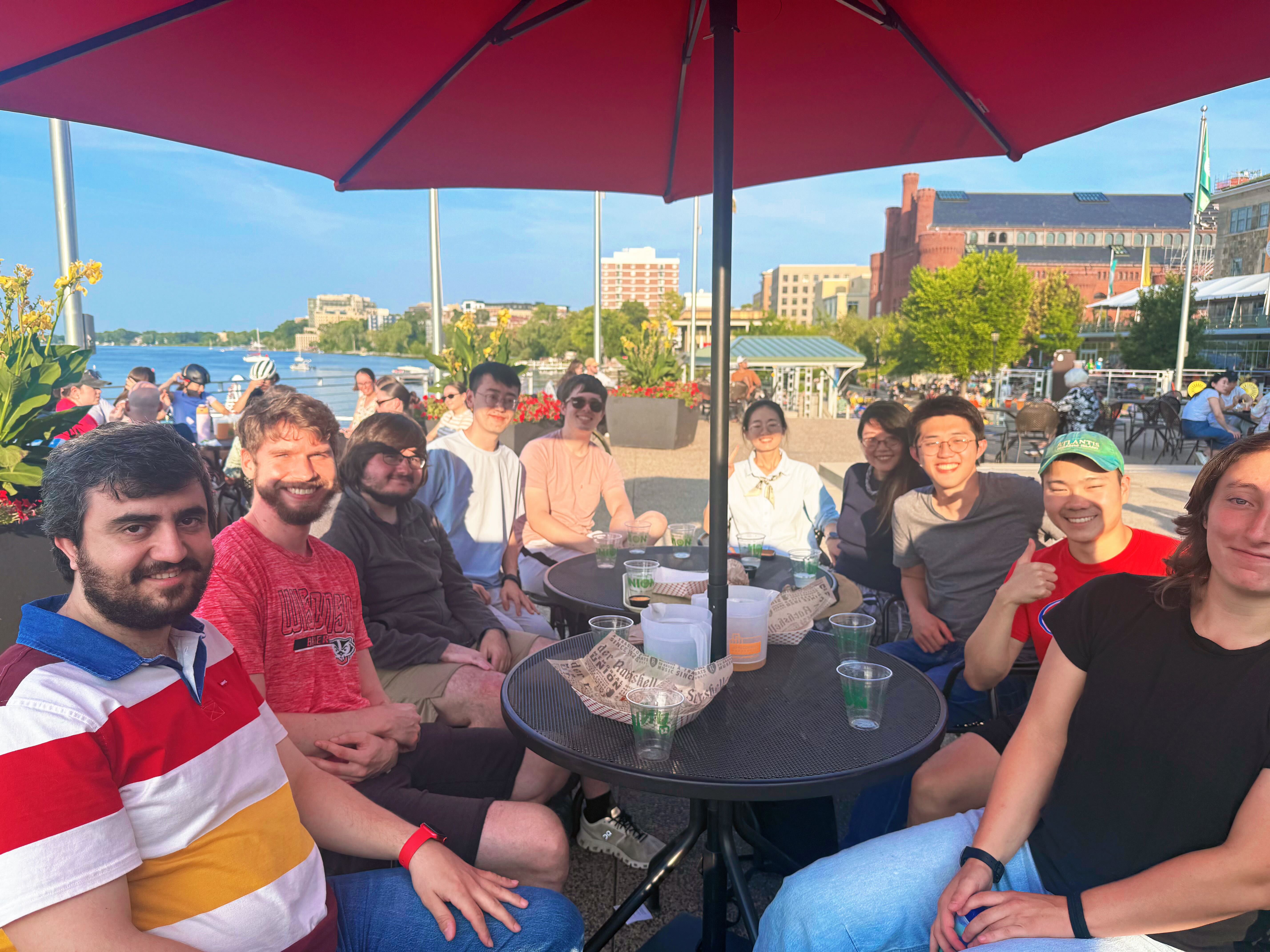
Postdoctoral Researchers
- Marco Muzio — Diffuse global fits, ultra-high-energy neutrinos, and multimessenger interpretation.
- Wei Tian — Neutrino flavour composition and Galactic-center studies.
- Yuhua Yao — Neutrinos from the Cygnus region, microquasars, and Galactic sources.
Alumni
- Pierpaolo Savina — Postdoctoral researcher working on ultra-high-energy photons and multi-flavour neutrino searches; now at the Gran Sasso Science Institute.
Ph.D. Students
- Zoë Rechav — Integrating partially contained cascades into diffuse astrophysical measurements using deep neural networks; maintaining the NNMFit diffuse fitting framework.
- Emre Yildizci — Next-generation diffuse neutrino global-fit targeting 10 PeV and beyond; particle shower parameterisations with FLUKA.
- Maxwell Nakos — Applying Graph Neural Networks to southern sky neutrino searches and extending them beyond 100 PeV, plus exploring transient ultra-high-energy sources with photon candidates detected by the Pierre Auger Observatory; generative AI particle-shower learning (CORSIKA 8 shower productions in air and ice).
- Matthias Thiesmeyer — All-flavour neutrino searches focused on the Galactic plane and Cygnus bubble; generative AI particle-shower muon-map validation and application for the inner-Galactic neutrino flux measurement.
- Leo Seen (co-advised with Prof. Ke Fang) — Correlating all-flavour neutrinos with >100 TeV photons detected by LHAASO; Galactic PeVatron searches.
- Anirudh Sundara Rajan (co-advised with Prof. Yong Jae Lee, Computer Science) — Generative modeling for particle tracking.
- Jesse Osborn (co-advised with Prof. Albrecht Karle) — Starting-track alerts and segmented Galactic diffuse measurements in the combined fit.
Alumni
- Vedant Basu (co-advised with Prof. Albrecht Karle) — Characterized the astrophysical diffuse spectrum using medium energy starting events (MESE); now a postdoctoral researcher at the University of Utah.
Master’s and Undergraduate Researchers
- Qiannan Wang — Three-dimensional particle-shower modeling with generative methods.
Alumni
- Ian Crawshaw — Parameterizing particle shower profiles.
- Yash H. Alapuria — Differential energy-flux measurements from the Galactic center.
- Siwei Wang — Parameterizing in-ice muon flux.
- Carter Shulick — Developing analytic parameterizations for photon propagation in transparent mediums.
- Wil Cram — Building a real-time neutrino alert website and developing augmented reality applications.
- Karter Bell — Developing hardware electronics for IceCube-Gen2.
- McCartney Evenson — Monitoring real-time alerts and analyzing neutrino self-correlations.
- Kieran Hizon — 10–100 PeV neutrino reconstructions.
- Calvin Sprouse (REU) — Energy reconstruction of 10 PeV neutrino candidate 190331A.
- Patricia McMillin (REU) — Geometry optimization for IceCube-Gen2.
- Alex Canales (REU) — GEANT4 simulations for detector figure-of-merit studies.
- Sam Benda — Undergraduate researcher on GPU photon simulations for next-generation optical modules; now a graduate student at UW–Madison.
High School Research Interns
- Isaac Hessman — Neutrino correlation studies with the Milky Way’s Galactic bubble shock front.
Alumni
- Levi Eberly — Anomaly pattern detection in real-time alerts.
- Collin Bovenmyer — Literature research on real-time neutrino counterparts in X-ray and gamma-ray.
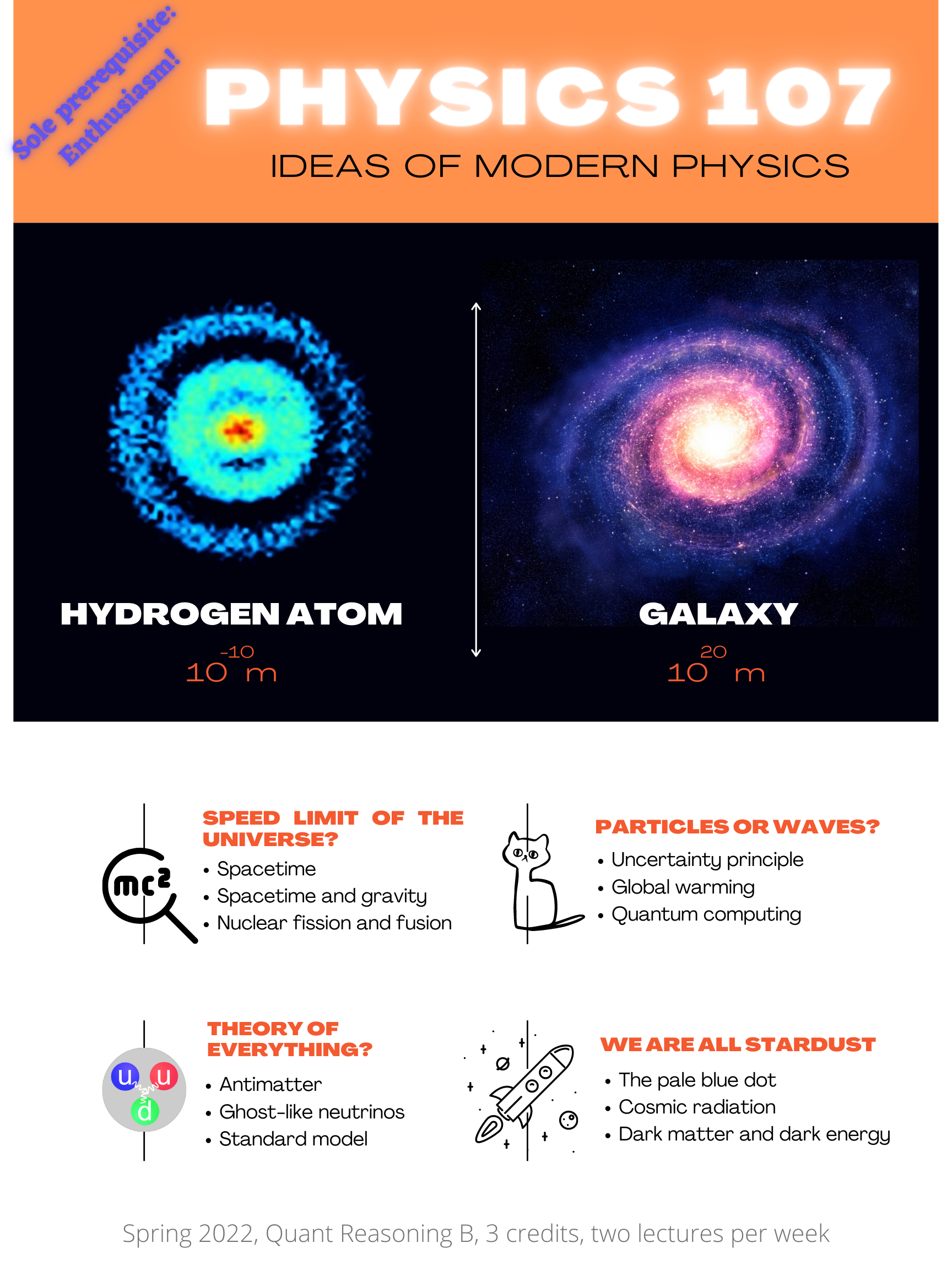
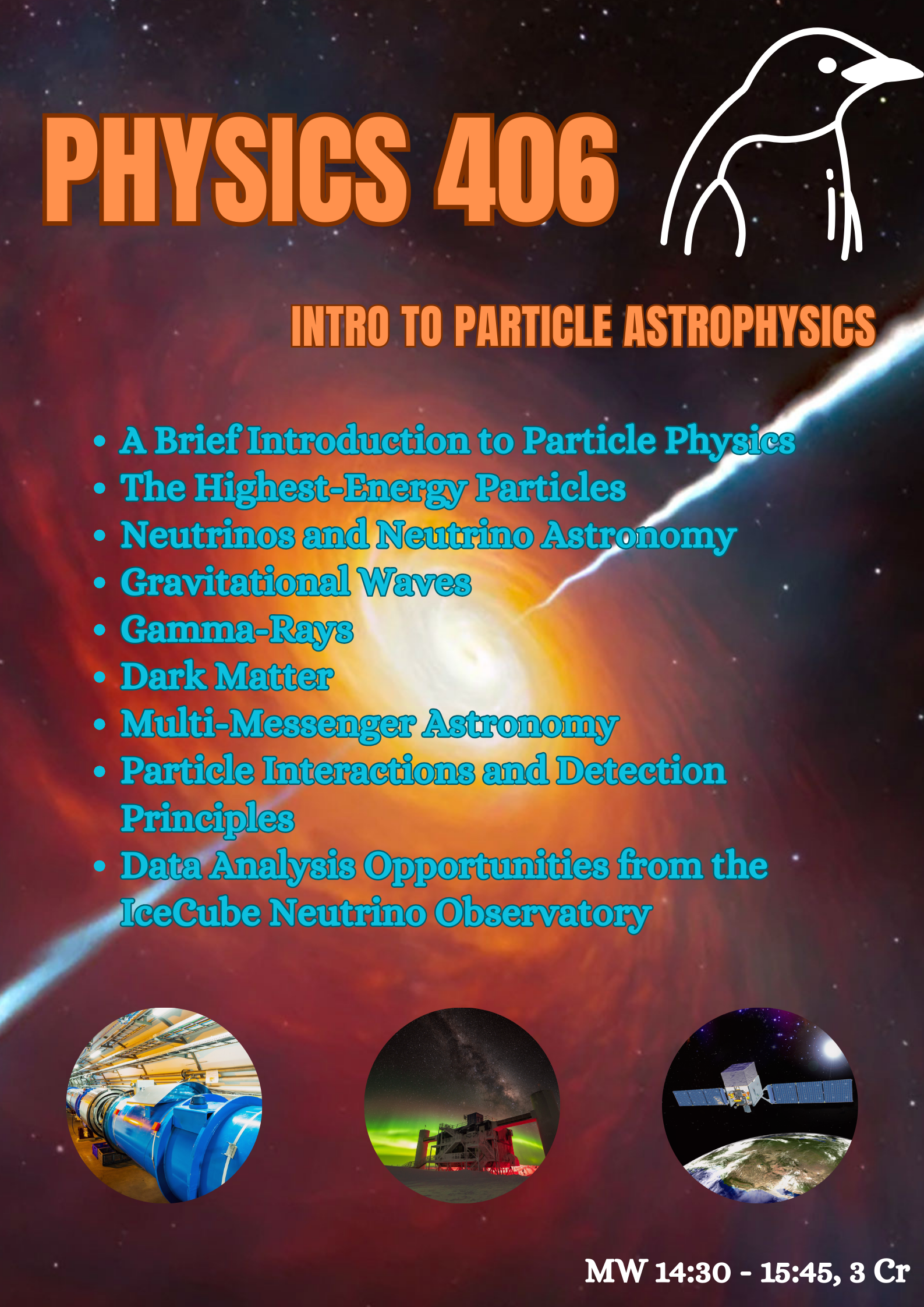
Public Engagement
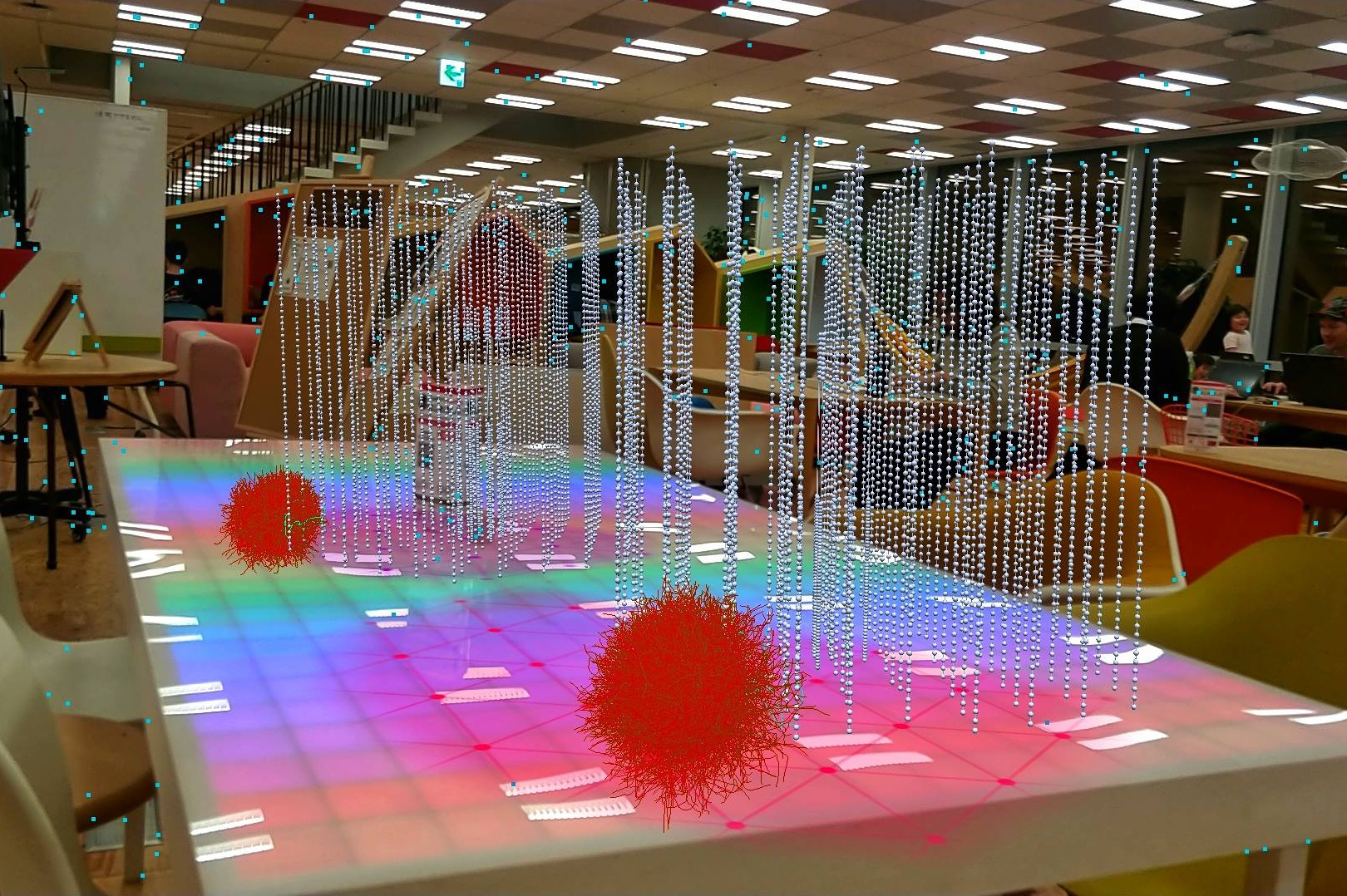
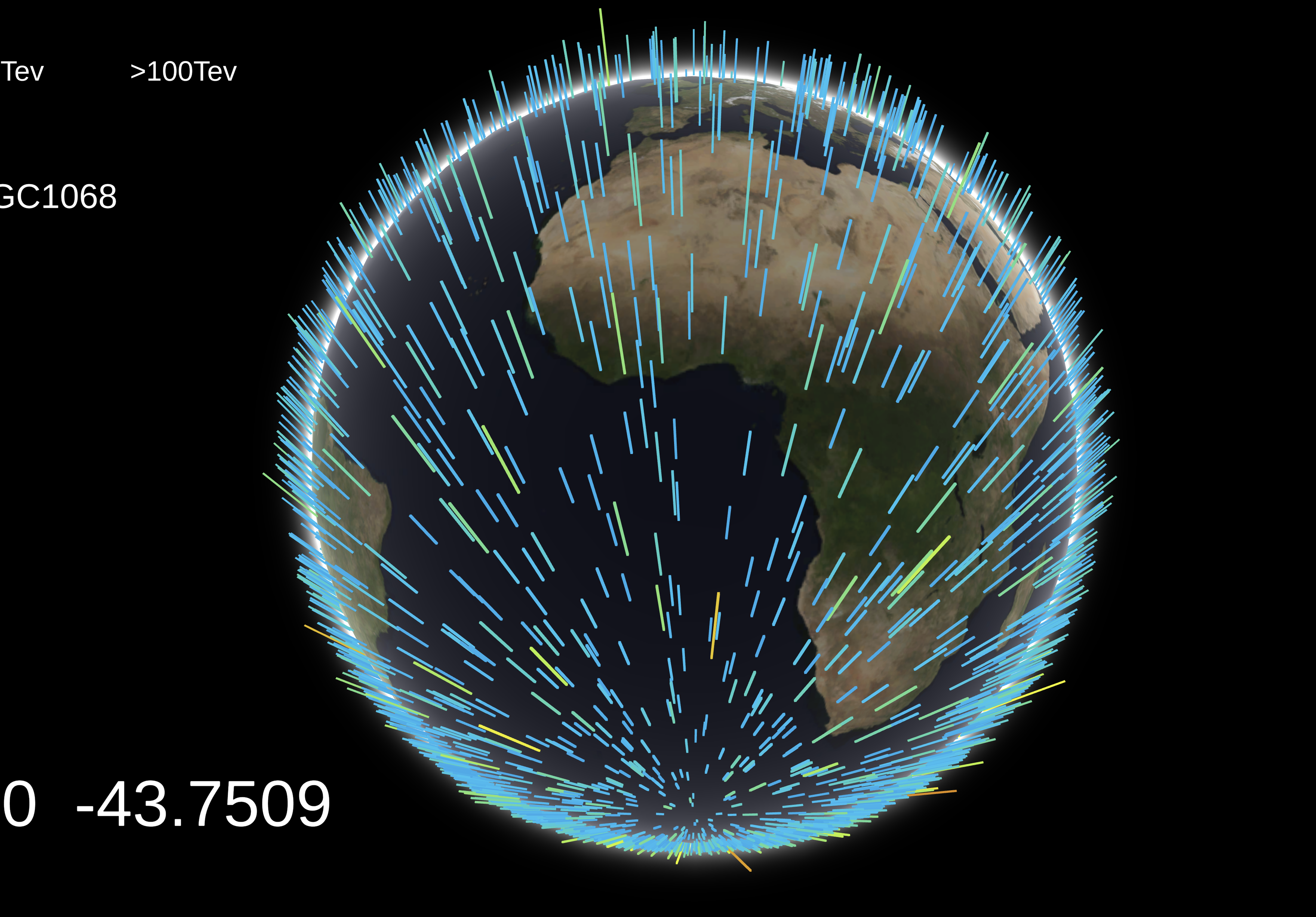
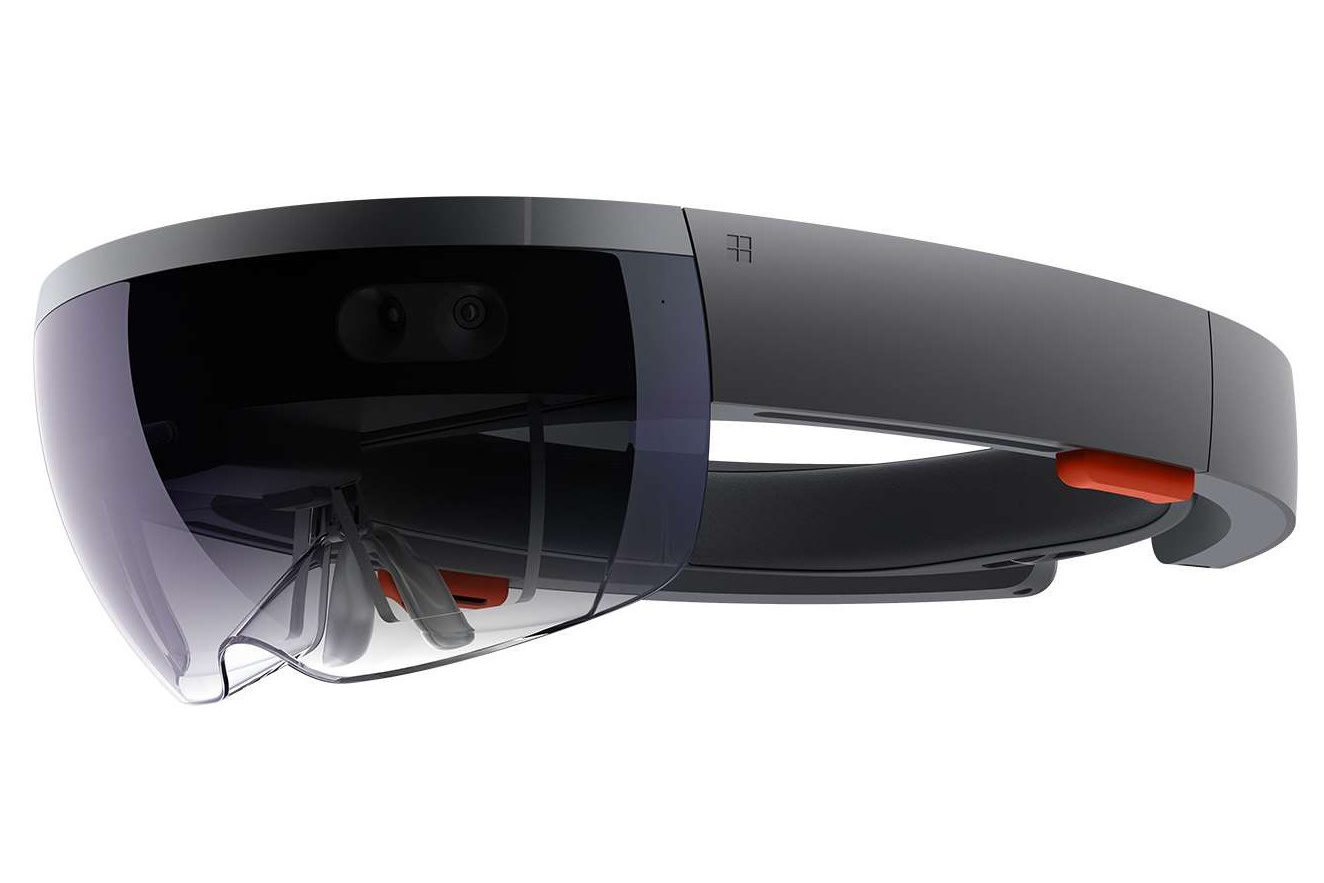
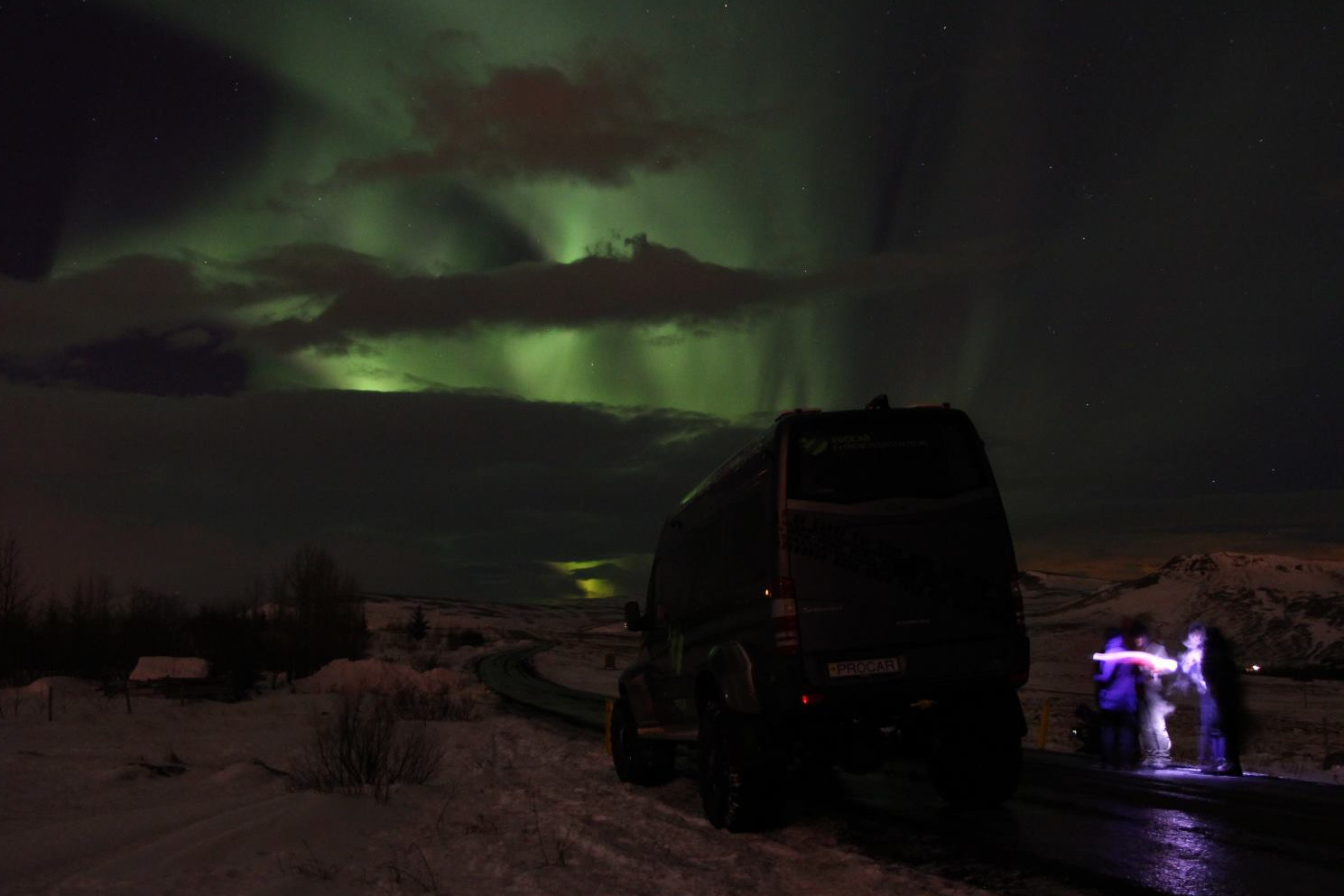
Games
Videos: project video 1 · project video 2
Selected Talks
- 2025Recent IceCube highlights including results from the multi-flavour Galactic neutrino search, Texas Symposium 2025
- 2024Searches for astrophysical and cosmological neutrinos, ICHEP 2024
- 2023Shower angular resolution in IceCube-Gen2 and implications on diffuse science, ICRC 2023
- 2022A decade of discoveries with Cherenkov neutrino telescopes, TeVPA 2022
- 2021Science Overview: the IceCube Neutrino Observatory, US-SCAR Science Meeting 2021
- 2020Radio detection for neutrinos, CRC townhall 2020
- 2019IceCube Alerts for high energy neutrino astronomy, AMON workshop 2019
- 2018Evidences of neutrino emission from the blazar TXS 0506+056 and results on Glashow resonance, UHECR 2018
- 2017Multi-flavour PeV neutrino search with IceCube, ICRC 2017
- 2016IceCube-Gen2: The next generation neutrino observatory in Antarctica, UHECR 2016
- 2015dual-PMT optical module (D-Egg) for IceCube-Gen2, ICRC 2015
- 2014Photon search at the Pierre Auger Observatory, SciNeGHE 2014