
preamble: this web page is a html-ized version of an e-mail which I sent to
To: Oxana Tarasova <tarasova@ifh.de>, Peter Steffen <steffenp@ifh.de>,
    marek kowalski <mpkowalski@lbl.gov>
Cc: Teresa Montaruli <teresa.montaruli@icecube.wisc.edu>,
    Brennan Hughey <hughey@plum.icecube.wisc.edu>,
    Juan de Dios Zornoza Gomez <zornoza@plum.icecube.wisc.edu>,
    Juan Carlos Diaz-Velez <juancarlos@plum.icecube.wisc.edu>,
    Paolo Desiati <desiati@plum.icecube.wisc.edu>,
    "Koepke, Lutz" <koepke@uni-mainz.de>, Markus Ackermann <ackerman@ifh.de>,
    Albrecht Karle <karle@plum.icecube.wisc.edu>
Note: after this mail I did more tests. I found/realized that:
I guess we should redo the tests described in this mail after these updates. Doing the comparison (between two vertex time algorithms) with only classic or only slart sieglinde would also be useful.
I did some study into the effect of the different vertex time definitions in cfirst.
I implemented a steering file flag in the SLART-style version of CFirst which allows you to choose between Peter Steffen's definition of the vertex time (default) and the recoos-definition (used if you set the flag).
Then I took a signal MC file provided by Brennan (anis, electrons) and ran CFirst & SPE Pandel (xyzt) & MPE Pandel (xyzt) reconstructions, with classic sieglinde, recoos and slart-style sieglinde, respectively; and the whole story with and without amplitude weighting in cfirst. (In the attached plots the 1st row is done *without* weighting in cfirst, in the 2n row *with* amplitude weighting.)
With slart-style sieglinde I ran the CFirst modules with the
"RecoosCompatibility" flag switched on, so they use the vertex time
associated with the earliest hit with NTRIG>=4 direct hits, whereas
classic sieglinde used Peter Steffen's definition (earliest vertex time
with NTRIG>=4 hits).
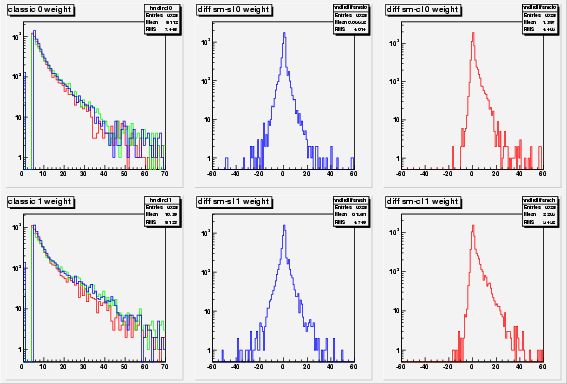
(Attachment 1)
In attachment 1 you see that this leads to slightly different vertex times. The global distributions may seem very similar, but in the difference plots you see that the difference between recoos and slart is a roughly symmetric distribution whereas for recoos-classic the difference is (of course) almost always (zero or) positive. The range of the difference is not as large as the direct hit window (200ns), but of the same order of magnitude.
(Attachment 2)
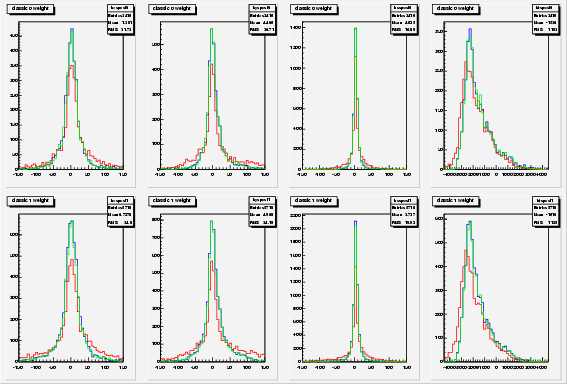
The direct hit distributions (direct hit w.r.t. vertex time, see attachment 2) are clearly different: with Peter Steffen's definition of the vertex time one gets less direct hits. When we apply the same cuts as Marek did then this results in a lower passing rate.
(Attachment 3)
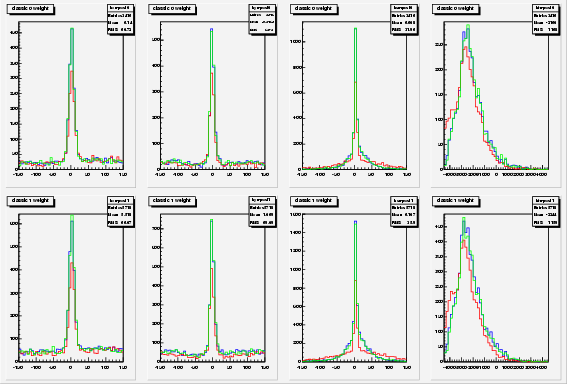
(Attachment 4)
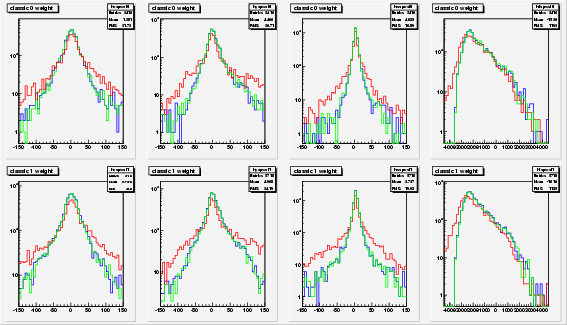
(Attachment 5)
(Attachment 6)

This is clear in the SPE and MPE Pandel vertex resolution plots (attachment 3-6). The difference with MC truth is plotted only for the events for which the standard L1 cascade trigger would be passed.
[ The standard L1 cascade trigger is: cfirst.ratio<0.05&&cfirst.ndir0>=8.
here "ratio" is the fraction of early hits w.r.t. tmax {where "early"
means a time residual between -1500 and -200ns and "tmax" is the vertex
time which would result in the most "direct hits" (I put quotes around
that, because I guess that many of those hits are probably actually from
scattered photons; by sliding the direct hit window to a later time you
catch more of them)}. ndir0 is the number of direct hits w.r.t. the vertex
time t0 (typically t0<=tmax). ]
In these vertex resolution plots red=classic, green=recoos and blue=slart.
Another effect in these plots is that the vertex resolution with the classic reconstruction looks worse than the resolution with recoos and slart, which seem to perform equivalently here.
My conclusion from these plots is that if we want to use the "standard L1 cascade cut", we'd better use the old definition of the vertex time from recoos/Marek. Peter Steffen's definition seems to make a bit more sense from a pure physics standpoint, but it would require a time consuming study to define cut values which are as good (or better?) as Marek's cut. Of course the quality depends not only on the ultimate vertex resolution but also on the signal and background passing rates.
Note that these plots only show signal MC (ANIS, electrons). I did not look at the performance with background MC (corsika). Neither did I look at Peter's modified PE weighting, since this is not available in recoos (as far as I know).
Currently the 2005 filtering runs with the recoos-style vertex time definition.
David

